The short answer
Standing water on a concrete driveway usually means the slab doesn’t have enough slope, part of it has settled, or water is running onto it from the yard or roof. Outdoor concrete should fall about 1/4 inch per foot, and Washington’s residential code calls for hard surfaces within 10 feet of the house to slope at least 2 percent away.
Why is there standing water on my concrete driveway or patio?
Usually for one of four reasons, and more than one can be at work on the same slab. In Clark County, where most of the year’s rain falls from October to May, a small problem shows up fast.
The slab was poured too flat
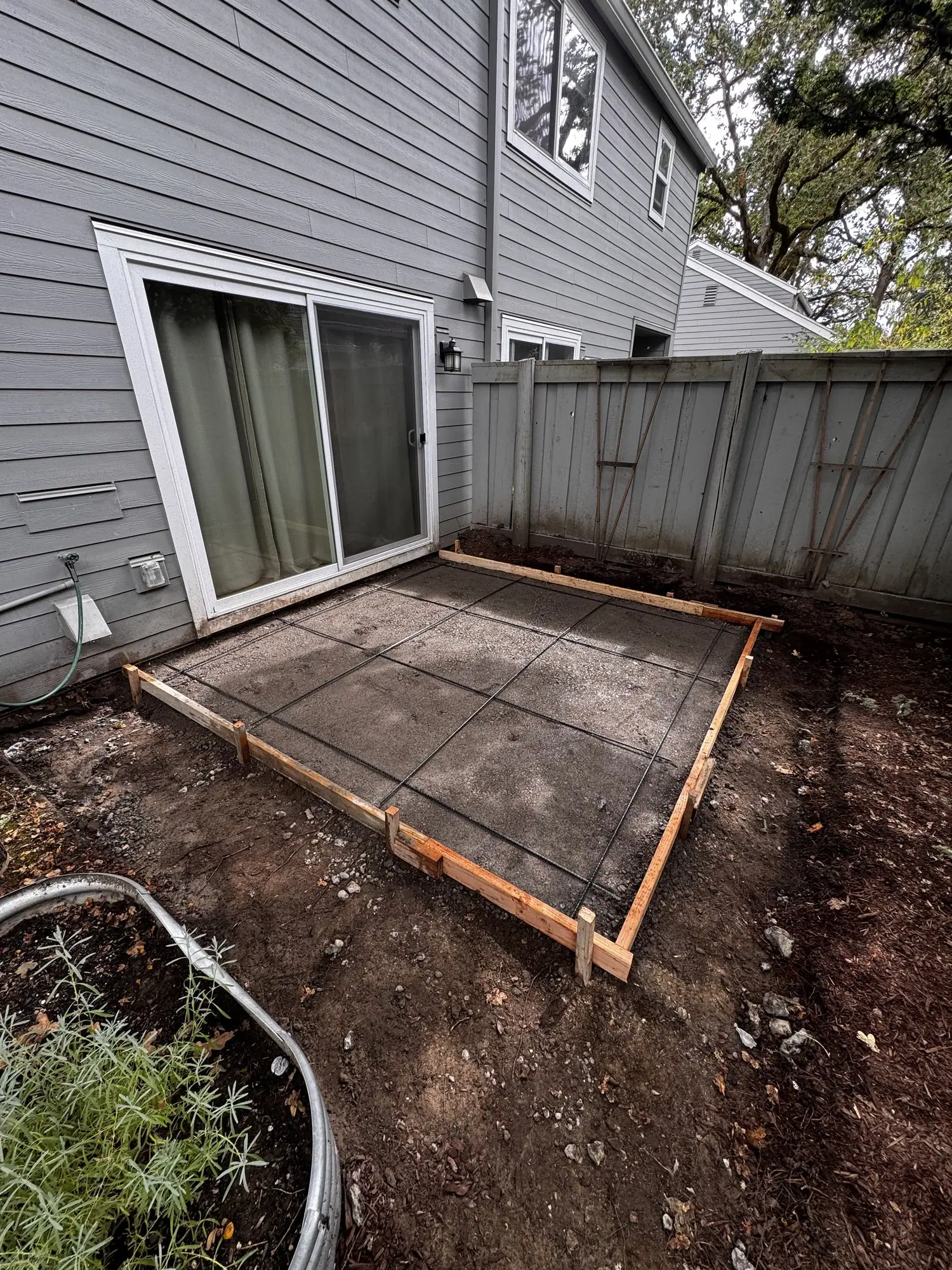
A slab gets its slope from the forms, which are set with a level and a string line before the pour. If they’re set too flat, or a dip is left while the surface is being finished, water has nowhere to go. This kind of puddle is there from the first rain.
Part of the slab settled
When the gravel base under a slab was too thin, wasn’t compacted, or washed out, the concrete sinks into the gap. It often happens next to the house, where soil was dug out for the foundation and filled back in, and near downspouts that keep the ground soaked. This puddle shows up or grows over months or years, often with a crack at the edge of the low section.
Part of the slab lifted
Tree roots can push one section up. The raised edge works like a dam and holds water on the section behind it.
Water is being sent onto it
A downspout that empties onto the driveway, a lawn or planting bed that sits higher than the concrete, or a neighbor’s yard that drains toward yours can put more water on a slab than its slope can move. Grass and soil built up along the edge can also trap water that would otherwise run off.
How much slope does a driveway or patio need to drain?
About 1/4 inch of fall for every foot, which is a 2 percent slope. That is the rule of thumb Concrete Network gives for driveways, patios and walkways, and it suggests up to 3/8 inch per foot where rain is heavy. Here is what those slopes look like over common lengths:
| Length of slab | Fall at 1/8 inch per foot | Fall at 1/4 inch per foot | Fall at 3/8 inch per foot |
|---|---|---|---|
| 4 feet (one level length) | 1/2 inch | 1 inch | 1 1/2 inches |
| 10 feet | 1 1/4 inches | 2 1/2 inches | 3 3/4 inches |
| 20 feet | 2 1/2 inches | 5 inches | 7 1/2 inches |
Next to the house, the code sets a minimum. Section R401.3 of the 2021 International Residential Code, which Washington adopted, says the ground should fall 6 inches in the first 10 feet away from the foundation. Where there isn’t room for that, it calls for drains or swales and says hard surfaces within 10 feet of the foundation have to slope at least 2 percent away from the building. A patio that sits level against the back wall, or tips toward it, falls short.
Slope has an upper limit too. Concrete Network puts the usual maximum for a driveway at about 15 percent, and Clark County’s plot plan checklist asks for fire chief approval on a finished driveway steeper than that.
You can check your own slab with a 4-foot level:
- Lay the level on the slab, pointing the way the water should run.
- Lift the low end until the bubble sits in the middle.
- Measure the gap under the end you lifted. About 1 inch means 1/4 inch per foot. A half inch or less means 1/8 inch per foot or flatter.
- Repeat in a few spots, then run a hose on a dry day and watch where the water goes. Trace the edge of the puddle in chalk so you can tell later whether it’s growing.
Is standing water on new concrete a sign it was poured wrong?
Not always. Concrete is finished by hand, so a large slab is never perfectly flat, and a few shallow wet spots that dry within hours of the rain stopping are normal. The building code sets how much a slab next to the house has to slope, but it doesn’t put a number on puddles.
These are worth a call to whoever poured it:
- A puddle that’s still there a day after the rain stops
- Water running toward the house, the garage door or a doorway
- A puddle sitting against the foundation or over a joint
- A low spot you can see when you lay a level or a straight board across it
Call the installer first. They know how the forms were set and what slope they were aiming for, and a problem raised in the first few months is easier to sort out than one raised years later. Rain itself doesn’t hurt a new slab once the surface has set. The thing to watch is the shape of the slab, not the water.
My driveway slopes toward the house. What can be done?
Catch the water before it gets to the house, or rebuild the part that tips the wrong way. Which one makes sense depends on how much of the slab is wrong and why.
- If a section near the garage settled and tipped back, lifting it can bring it back to its old slope. The next section covers that.
- If the driveway runs downhill to the garage because the lot slopes that way, a trench drain across the driveway in front of the garage door catches the water and pipes it away.
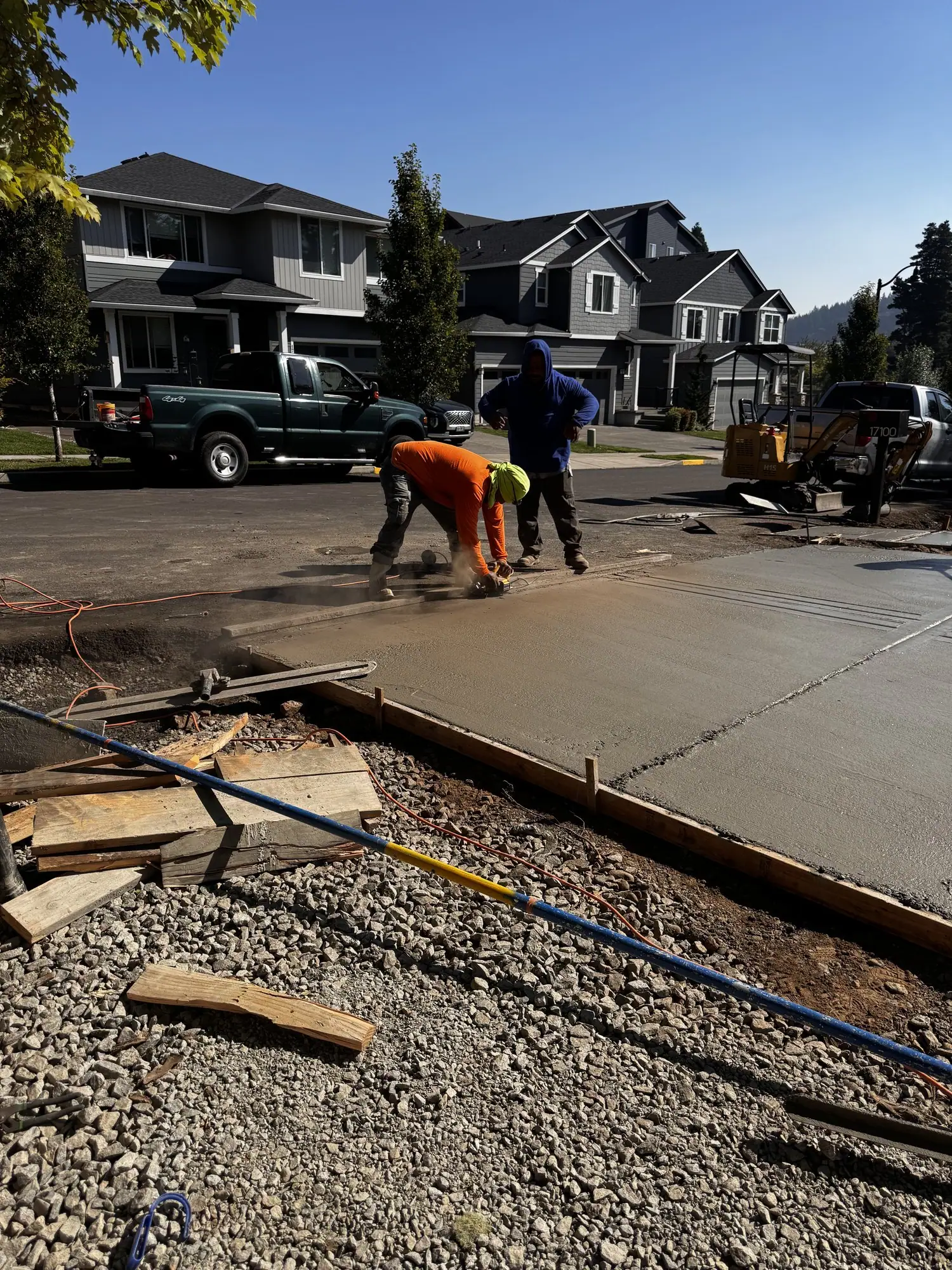
- If only the sections next to the house are wrong, they can be cut out at the joints and replaced with new concrete formed to slope away.
Concrete Network is blunt about the last case: when a slab doesn’t have enough slope or is pitched the wrong way, there isn’t much to do except remove and replace it. It also names slabs pitched toward a home as one of the major causes of basement leaks, so this is worth fixing before the wet season, not after a winter of water against the foundation.
MJ Concrete does driveway replacement and drainage for paved areas, so the slab and the drain can be planned as one job.
Can a low spot be fixed without tearing out the slab?
Sometimes. If a slab sank in one piece, it can often be lifted back into place. If it was poured flat, or the dip is in the middle of a section, lifting won’t change its shape.
Lifting works by filling the gap under the slab so it rises. HomeAdvisor’s concrete leveling cost guide lists three ways to do it. These are national published ranges, not quotes.
| Method | What goes under the slab | Published cost per square foot |
|---|---|---|
| Mudjacking | A slurry of water, cement and soil, pumped in through holes | $3 to $6 |
| Foam jacking | Polyurethane foam, injected through holes | $5 to $25 |
| Sandjacking | Dry sand or limestone, after the slab is raised with jacks | $3 to $8 |
The same guide puts the average leveling job at $1,241, with most between $662 and $1,883, and a driveway at $650 to $3,200. It says mudjacking done properly lasts 8 to 10 years, longest where the surface doesn’t carry a constant heavy load.
Lifting fills the gap but doesn’t fix why it opened. If water washed out the base, send that water somewhere else first, or the slab can sink again. When a section is broken into pieces, or the low spot is in the surface itself, replacing that section between its joints is usually the cleaner fix, and that is the kind of concrete repair MJ Concrete does.
When does a trench drain make sense?
When the slab can’t be sloped away from the problem. A trench drain, also called a channel drain, is a narrow channel set into the concrete with a grate on top. It catches water along its whole length and carries it through a pipe to a place that can take it.
It usually earns its place in spots like these:
- Across a driveway in front of a garage that sits lower than the street
- In a patio poured between the house and another structure, where Concrete Network suggests sloping both sides in toward a channel drain in the middle
- Where a driveway runs down into a walkway or patio that has nowhere to shed water
The drain is only as good as its outlet. The pipe has to run downhill the whole way to somewhere the water is allowed to go, so that is the part to plan first. The price depends mostly on the drain’s length, cutting the existing slab, and how far the pipe has to run, which is why it has to be measured on site.
Does pooling water damage concrete in a wet, freezing winter?
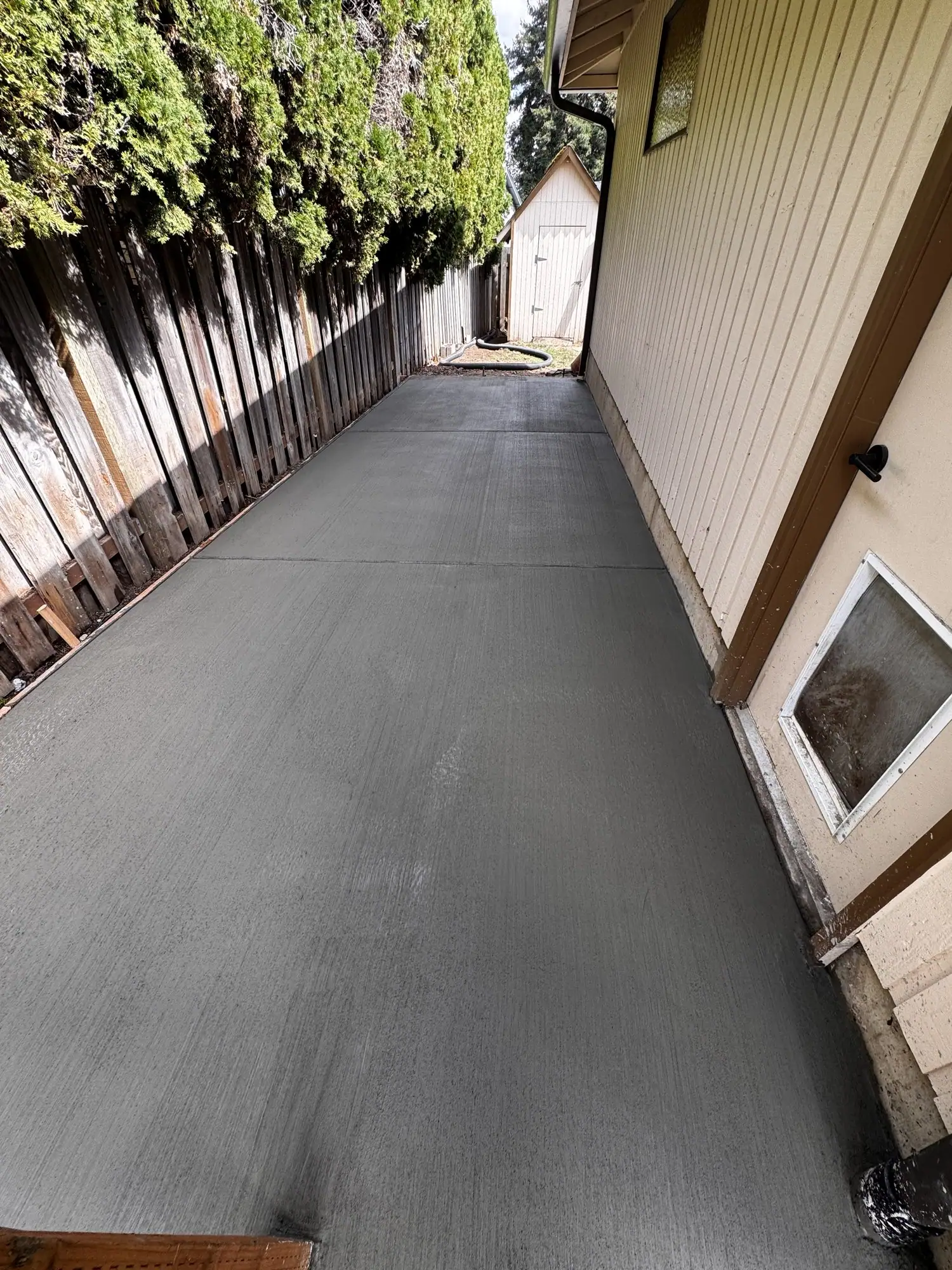
It can. Clark County gets a few hard freezes most winters, and the concrete under a puddle is the wettest concrete on your property. The Federal Highway Administration’s brief on deicers and concrete says concrete that freezes while critically saturated, above about 86 percent, can be damaged in a single freeze-thaw cycle, no matter how much entrained air it has. Entrained air is the tiny bubbles that can be mixed into concrete to give freezing water room to expand.
The same brief says deicing salts make freeze damage worse, partly by raising how much water the surface holds, so a low spot that gets salted takes the most punishment. Standing water also turns to ice right where people walk and park, and in this climate a spot that stays wet grows moss and algae that stay slick most of the year.
Until it’s fixed, push the water off with a broom before a freeze, and go easy on salt in that spot.
Where is the water allowed to go?
Away from the house, to a place that can take it without causing a problem, and in Vancouver, not off your property. Section R401.3 of the residential code says surface drainage has to go to a storm sewer or another approved collection point that doesn’t create a hazard. The City of Vancouver’s driveway permit page adds that all drainage must remain on-site.
So a drain that empties onto the sidewalk or into a neighbor’s yard just moves the problem, and in Vancouver it breaks the rule. Ask the city before you run a pipe toward the street, because any work in the public right-of-way needs a right-of-way permit. Outside Vancouver, ask your city or the county what they allow.
Bigger projects bring stormwater rules. In Vancouver, adding or replacing 2,000 square feet or more of hard surface falls under the city’s stormwater and erosion control codes.
Fixing it also matters when you sell. Washington’s seller disclosure form asks whether there have been any flooding, standing water or drainage problems on the property.
About MJ Concrete
MJ Concrete is a concrete contractor in Vancouver, WA, owned and run by Tevita Lehauli, pouring driveways, patios, walkways, foundations and walls across Clark County since 2019 (7 years). Every estimate is free and done in person. More about us.