The short answer
Concrete RV pad cost runs about $8 to $10 a square foot for a 6-inch slab in HomeGuide's published ranges, so a 12 by 40 foot pad comes to roughly $3,840 to $4,800 before digging, base rock and permits. These are published ranges, not MJ's prices. In the City of Vancouver, every new RV pad needs a permit.
How much does a concrete RV pad cost in Vancouver, WA?
Plan on about $8 to $10 a square foot for the slab itself. That is HomeGuide’s published range for a 6-inch concrete slab, the thickness most RV pads need, and it covers the concrete, forms and labor. The same HomeGuide guide lists $1,200 to $8,400 for an RV pad of 200 to 700 square feet, and Angi’s concrete slab guide gives an average of $3,840 for a 640 square foot RV pad. These are national figures published by cost guides, not MJ Concrete's prices, and they leave out the digging, base rock, approach work and permits covered further down.
Here is what HomeGuide's 6-inch rate works out to for common pad sizes, before any extras:
| Pad size | Square feet | 6-inch slab at $8 to $10 a sq ft |
|---|---|---|
| 12 x 30 ft | 360 | $2,880 to $3,600 |
| 12 x 40 ft | 480 | $3,840 to $4,800 |
| 14 x 45 ft | 630 | $5,040 to $6,300 |
| 14 x 50 ft | 700 | $5,600 to $7,000 |
| 14 x 60 ft | 840 | $6,720 to $8,400 |
For a local check, HomeAdvisor’s Vancouver page lists an average of $5,009 for concrete driveway and flatwork jobs here, with most between $2,643 and $7,402. A mid-size RV pad lands in that range once the extras are added. If you want the pad to match a broom finish or exposed aggregate driveway, our concrete cost guide for Vancouver has the published price per square foot for each finish.
Two things push a pad toward the top of these ranges: soft or wet ground that needs more digging and rock, and a pad that has to connect to a new or wider approach at the street. Small pads also cost more per square foot than big ones, because the crew, the truck and the setup cost about the same either way. For a real number for your lot, Tevita comes out, measures and gives you a price before any work starts. Call or text (360) 771-3512.
How big should an RV pad be?
Make it at least 12 feet wide and several feet longer than the rig. Angi’s driveway width guide recommends 12 feet instead of 10 for any driveway that will hold a work truck, RV or trailer long term, with a length of at least 30 feet. That is a floor, not a target. Measure your own rig before you settle on a size.
Measuring a travel trailer or a motorhome
For a travel trailer or fifth wheel, measure from the front of the hitch to the back bumper, including the tongue. For a motorhome, include the ladder, bike rack or anything else hanging off the back. Then measure the width with the slide-outs open, because you will want to open them on the pad to air the rig out or load it. If you want room to walk all the way around, open the door, or wash the rig without stepping in mud, 14 feet wide gives you about a foot more on each side than a 12-foot pad.
A motorhome is usually much heavier than a travel trailer of the same length, so it is the one that most needs the thicker slab and deeper base described below. A trailer brings its own issue: you back it in with a truck, so the pad and the driveway need enough room to swing in from the street.
Where the pad can go
Most RV pads go in a side yard or beside the existing driveway. In the City of Vancouver, the city's guide to parking on private property says RVs, boats and trailers must sit on an improved, all-weather surface and can't be stored in the required front yard setback except on a driveway. So a pad in the front yard has to work as part of the driveway, and a side yard pad has to respect the side setbacks for your lot. A planner checks this when you apply for the permit, so sketch the location before you collect bids.
How thick should a concrete RV pad be, and does it need rebar?
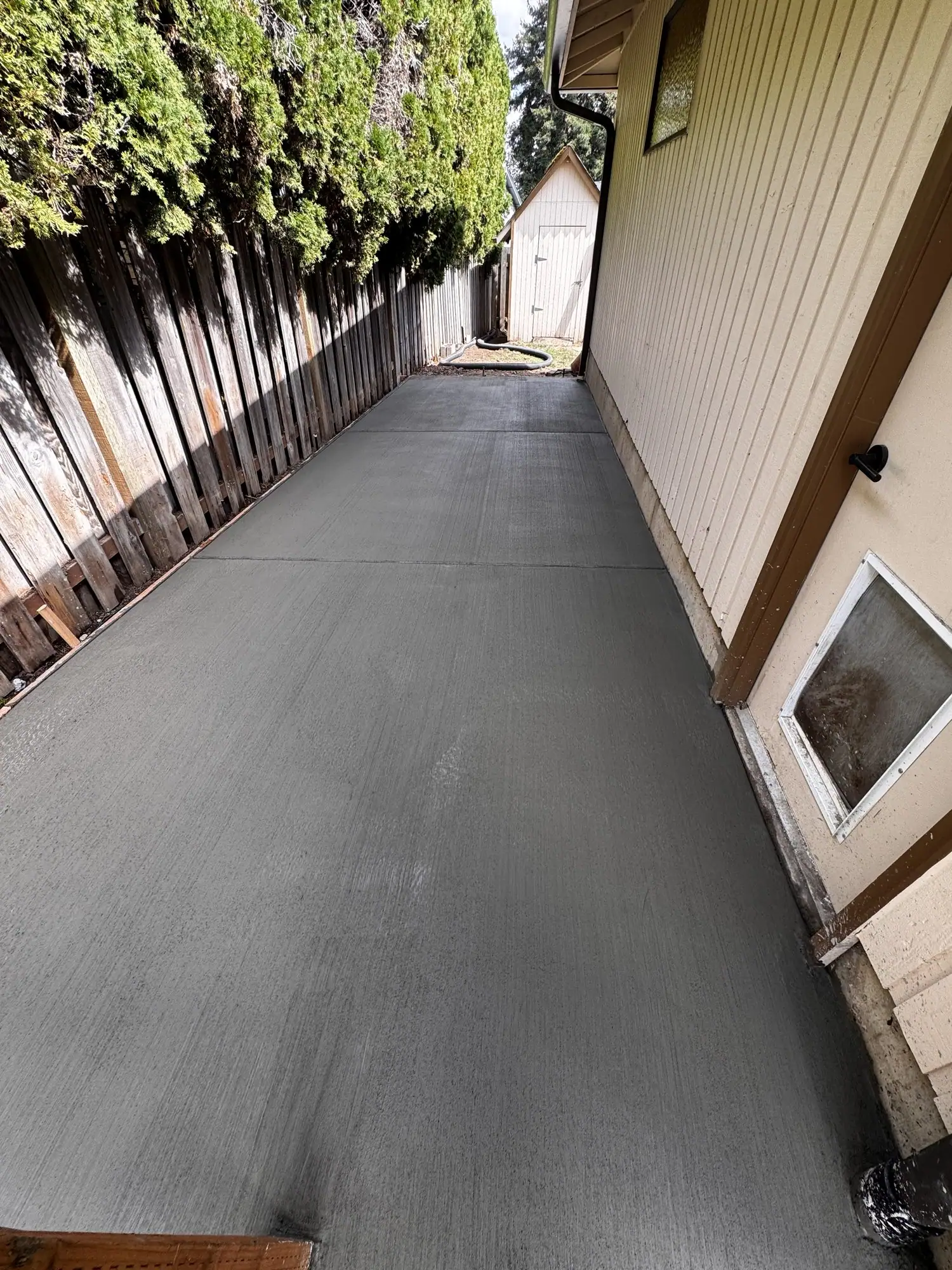
Pour an RV pad 5 to 6 inches thick, not the 4 inches most car driveways get. HomeGuide’s driveway guide recommends 5 to 6 inches for RVs, with the edges thickened to 6 to 8 inches because edges are where slabs break first. HomeAdvisor says 6 or 8 inches suits heavy vehicles. For a large motorhome, 6 inches is the safer choice. The extra inch or two of concrete costs far less than breaking out a cracked pad later.
What's under the slab matters as much as the slab. The sod and soft topsoil come out, the ground is shaped so water will run off, and crushed rock goes back in, packed down in layers until it's firm. Ground that stays wet through the rainy months gives way under a heavy load, and a loaded rig puts its weight on a few tires and jacks for months at a time. A good estimate says how deep the dig goes and how much rock goes back in. That part of the job is excavation and grading, and it is where cheap bids usually cut corners.
Rebar or wire mesh
Use rebar for an RV pad. Neither rebar nor mesh stops concrete from cracking; joints do that. What the steel does is hold the pieces together and keep them level if a crack opens. Rebar is stiffer, and it sits on small supports called chairs so it stays in the middle of the slab during the pour, where it does its job. Wire mesh is fine in light slabs but is easy to push to the bottom of the concrete as the crew walks on it, where it does very little. HomeGuide puts rebar at $1 to $3 a square foot extra.
Joints
Concrete shrinks as it cures and moves with the seasons, so every slab cracks somewhere. Control joints, tooled or saw-cut lines across the pad, decide where. On a 12 or 14 foot wide pad they usually run across the width at regular spacing. Where the pad meets the existing driveway or the house, an isolation joint lets the two move separately so one doesn't crack the other.
Is a gravel RV pad cheaper than concrete?
Up front, yes. HomeGuide lists a gravel base at $1 to $3 a square foot for the rock, and its driveway cost guide puts a finished gravel driveway at $4 to $10 a square foot installed, against $8 to $10 for a 6-inch concrete slab. Over the years the gap closes. HomeGuide notes a gravel driveway needs raking and new gravel once or twice a year, and under an RV the rock gets pushed out from under the tires and jacks, leaving ruts that hold water. Moss and weeds grow in it, and mud ends up on the driveway and in the rig.
Inside Vancouver city limits, the choice may already be made for you. The city's guide to parking on private property says gravel is not an approved surface for parking or storing vehicles, and its driveway and RV pad permit page says the same about driveways: they must be paved, and gravel is not permitted. The guide says the city's Planning Official can approve another permanent surface, so if you have a reason to want something other than asphalt or concrete, call Planning at 360-487-7803 before you price it.
In unincorporated Clark County, ask Clark County Permit Services (564.397.4078) what surface they accept for an RV pad before you buy rock. Either way, a concrete pad gives you a flat, hard place to level the rig, set the jacks and wash it, and it doesn't need new rock every year.
Do you need a permit for an RV pad in Vancouver or Clark County?
Yes in both. The City of Vancouver says adding a new RV pad always requires a permit, and often more than one. Unincorporated Clark County's residential permits page lists “adding or replacing a driveway or RV pad” among the projects that need a residential permit. The same county page says plain concrete slabs poured on the ground don't need one, but it lists driveways and RV pads separately, so don't treat an RV pad as a patio.
In the City of Vancouver
The city's process has five steps:
- Fill out the city's residential driveway or RV pad permit request form and upload a simple site plan showing what's there now and what you want to build.
- A planner enters your application, emails you the fee, and tells you whether you also need a right-of-way permit.
- Pay the fee online, by mail or in person.
- A planner reviews your site plan.
- Once it's approved, the city issues an over-the-counter (OTC) land use permit and work can start.
If the pad needs a wider driveway approach, a new curb cut or new sidewalk at the street, that work also needs a right-of-way permit, and the city issues it only to a licensed contractor on its approved list. The city also says all drainage must stay on your property, so the pad can't send its runoff into the street or onto a neighbor's lot. The page doesn't publish the fee; the planner emails it after your application is in.
In unincorporated Clark County and other cities
Outside Vancouver city limits, the residential permit comes from Clark County Community Development. A new driveway cut onto a county road is a separate Approach/Sidewalk (APS) permit. If you live in Camas, Battle Ground or another city in the county, that city's own permit counter handles it instead, so call them first.
If you have an HOA, check its rules as well. Many limit where an RV can be parked or ask for screening, and their approval is separate from the city's. Get it in writing before the pour.
What adds to the price of an RV pad?
The slab is only part of the bill. These are the items that most often show up as separate lines on an RV pad estimate, with the published range for each. Not every job needs all of them.
| Item | Published range | Source |
|---|---|---|
| Digging and grading the site | $700 to $2,500 on average | HomeGuide |
| Compacted gravel base | $1 to $3 per sq ft | HomeGuide |
| Rebar | $1 to $3 per sq ft | HomeGuide |
| Breaking out and hauling old concrete | $3 to $8 per sq ft | HomeGuide |
| New driveway apron at the street | $1,530 to $4,320 | HomeAdvisor |
| Sealing the finished pad | $1 to $3 per sq ft | HomeGuide |
Access to the spot
If the concrete truck can back up and pour straight into the forms, the job moves fast. A pad behind a fence, past a tight gate or up a slope may need the concrete pumped or wheeled in, and the digging done with smaller machines. Both add labor. If a section of fence can come down for a day, it often saves money.
The approach and curb cut
If your current driveway opening is wide enough to swing the rig in, the pad can tie into it. If not, widening the approach means cutting the curb and pouring new concrete in the public right-of-way, which brings in the right-of-way permit above and the apron cost in the table.
Drainage
A 600 square foot slab sheds a lot of water in a Vancouver winter. It needs to slope away from the house and toward a spot that can take the water, and since the city requires drainage to stay on your property, some pads need a drain, or downspouts piped under them. That is drainage work for paving, and it is cheaper to plan before the pour than to fix after.
Should you add power, water or a dump hookup while it's being built?
If you think you'll want them, yes: put the pipes in before the pour. Running conduit for an outlet, a water line or a sewer cleanout under the slab is easy while the ground is open and expensive once the concrete is down. Each is its own trade, usually with its own permit, so get each one priced on its own.
Power
Inside Vancouver city limits, the City of Vancouver issues electrical permits and does the inspections itself; Washington L&I lists Vancouver among the cities that do. In unincorporated Clark County, the county doesn't issue electrical permits, and the permit comes from L&I (360.896.2300). Have the electrician tell you where the conduit should come up before the forms are set.
Water and sewer
Clark County's residential permits page says a connection to public water or sewer, or to an existing septic system, needs permits and approvals from other agencies. An RV dump connection to your sewer line is that kind of connection, so ask before you plan one. A hose bib nearby and a cleanout you can reach are often enough for filling and flushing tanks.
A hookup doesn't make the pad a place to live. The City of Vancouver's guide to its code says nobody can occupy an RV on a property for more than 14 days in a calendar year, so plan the pad for storage and trip prep.
How long before you can park the RV on new concrete?
Wait about four weeks before parking a heavy RV on a new pad. HomeGuide's driveway guide says to wait at least 7 days before driving a car on new concrete, and recommends the full 28 to 30 day cure for heavy vehicles. Concrete keeps getting stronger for weeks after the pour, and a motorhome's weight sits on a few small spots for months.
Cold weather slows curing. Vancouver gets most of its rain from October to May and a few hard freezes most winters, so a pad poured in late fall should get the long end of every number here. When you do park, put wood blocks or jack pads under the stabilizer jacks, and keep the jacks back from the slab edges for the first season.
The work before the pour usually takes a few days: digging, base rock, forms and steel, then a pour day and a few days of light curing before the forms come off. Before any digging, Washington law (RCW 19.122.030) requires a utility locate through 811 at least two full business days before work starts. Side yards often have water, power, irrigation or septic lines crossing them, and the locate marks them first.
About MJ Concrete
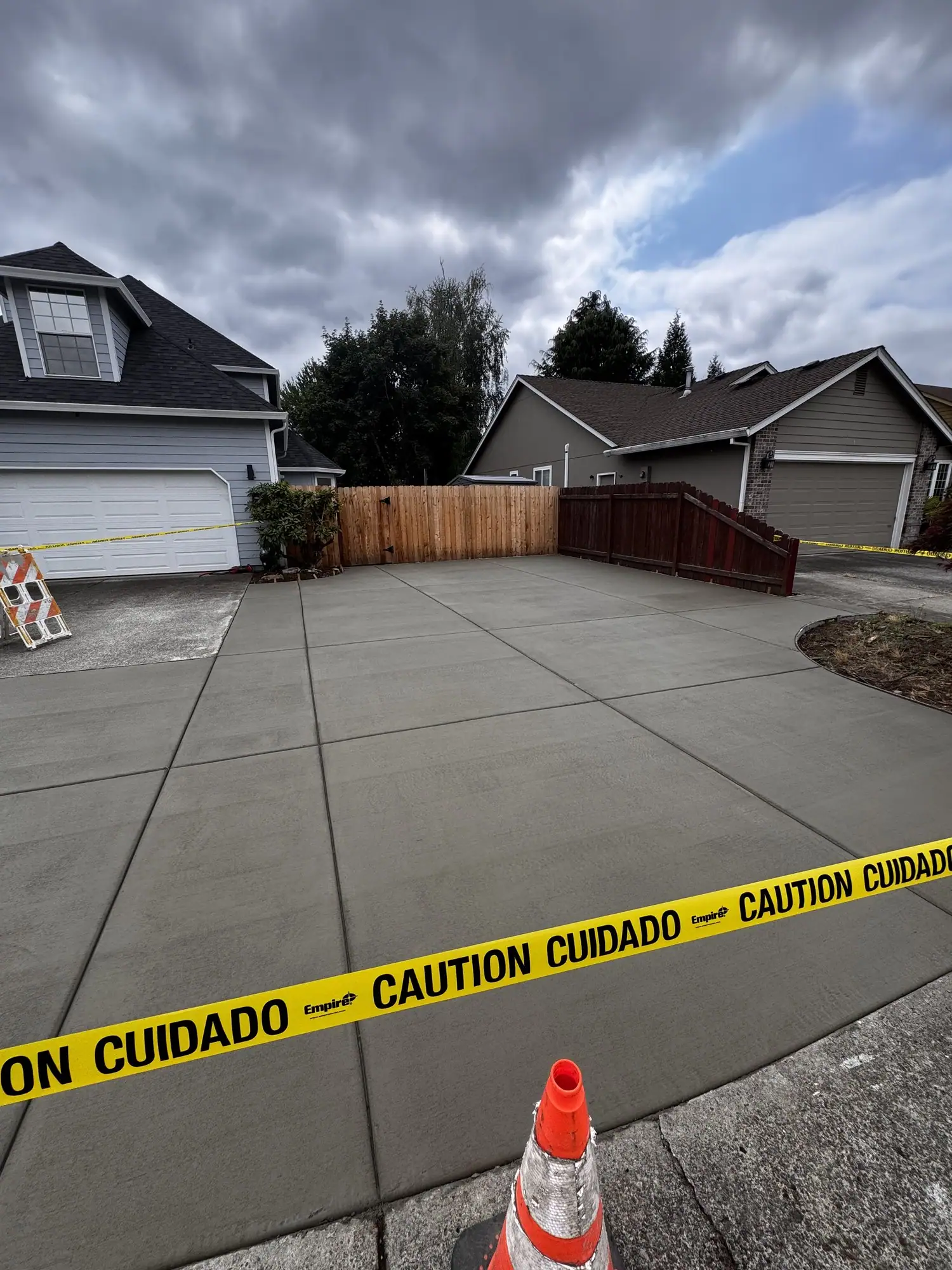
MJ Concrete is a concrete contractor in Vancouver, WA, owned and run by Tevita Lehauli, pouring driveways, patios, walkways, foundations and walls across Clark County since 2019 (7 years). Every estimate is free and done in person. More about us.